Compared to its two neighbours, Gran Canaria and Tenerife, Lanzarote is considered a very quiet, perhaps rather dull place to go for a holiday. Fortuitously, It has escaped the excesses of tourism because of a unique partnership, between the internationally-renowned sculptor-architect, Cesar Manrique and his childhood friend Jose Ramirez Cerda, who was president of the island’s council. Manrique’s vision was for sustainable, art-integrated tourism on the island and his position as artistic director enabled him to realise that vision. That was 50 years ago, which makes him a remarkable environmental activist and a great role model for our own age.
There are some wonderful examples of architectural interventions integrated into the landscape, and all development on the island is required to be low-rise and painted white, which gives it a sense of aesthetic harmony, offset by the black volcanic landscape.
Geologically the island is unusual, because it is a shield volcano with many vents and large lava flows that have covered much of the island, but the very low rainfall (typically 125-150mm a year) means that the pyroclast has not broken down into volcanic soils. Between 1730-1736 some 30 volcanoes erupted covering a quarter of the island with lava and wiping out much of the island’s productive farmland. Lanzarote’s premier tourist attraction has become the Parque Nacional de Timanfaya, an extensive, surreal, lunar-like succession of volcanic landscapes with an active volcano.
Human ingenuity has created a unique agrarian landscape on the island. Countless small pits have been created with low semi-circular stone walls, designed to harvest dew from the overnight humidity of the sea breezes, and the little rainfall there is and protect the plants from the strong Atlantic winds. The crops, such as grapes (malvasia wine) and figs are intensely flavoured. UNESCO declared Lanzarote a Biosphere Reserve in 1993, and in 2015 it became the first destination to receive the Biosphere Responsible Tourism Certificate.
In the north of the island at Guatica, fields of prickly pear cactus are to be found, grown in order to harvest the cochineal insects (used to produce a deep red food dye) when the cacti come into flower. It was the local demand for volcanic pumice, which is used for water retention on the fields of cacti, that created the large deep amphitheatre that is now the site for the Cactus Garden.
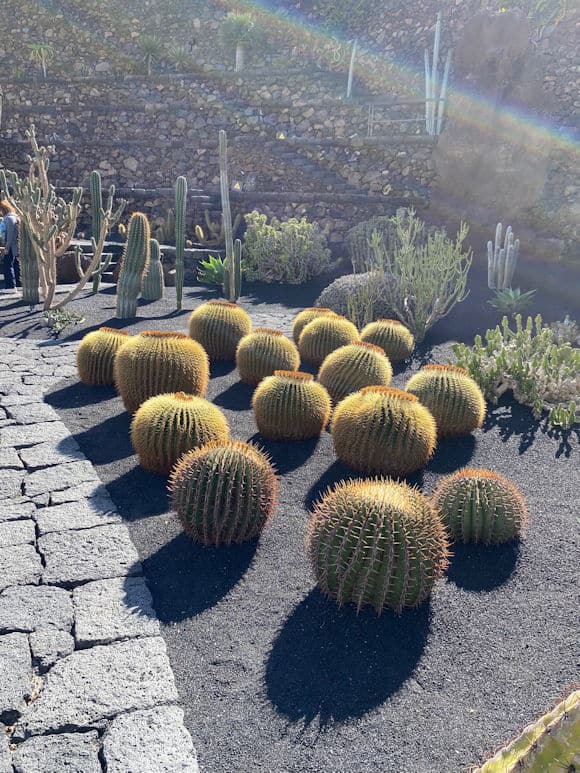
By the early 1970s, Manrique had already produce several landscape interventions, such as Jameos del Agua and Mirador del Rio (a companion garden story) and together with botanist curator Estanislao Gonzalez Ferrer started work on the Cactus Garden. Completed in 1990 it was his last project. He was killed in a car accident in 1992, aged 73, a great loss to Lanzarote and the environmental movement.
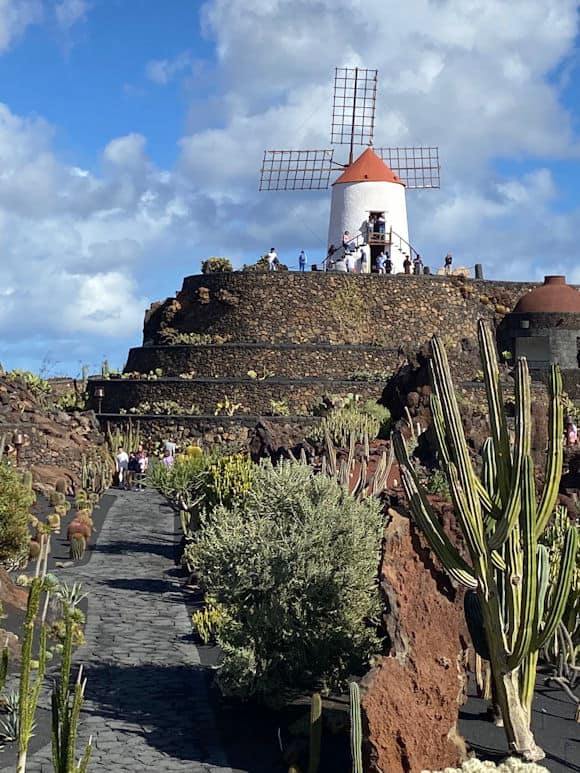
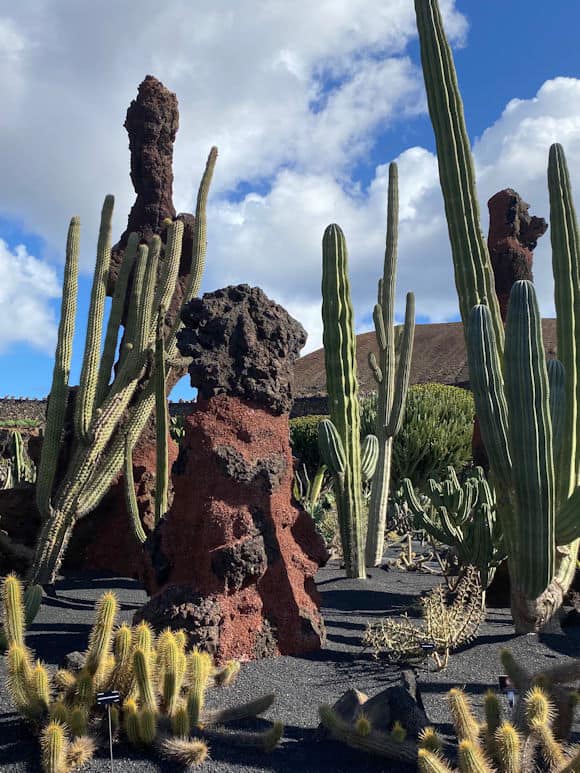
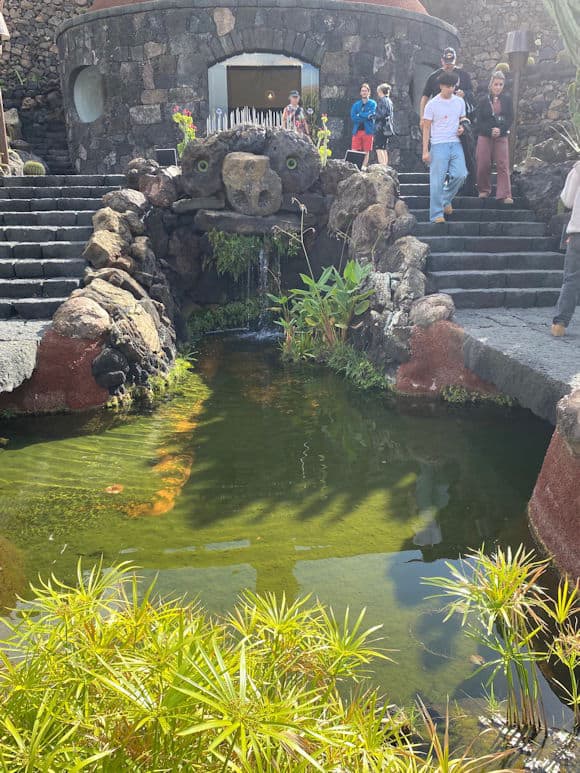
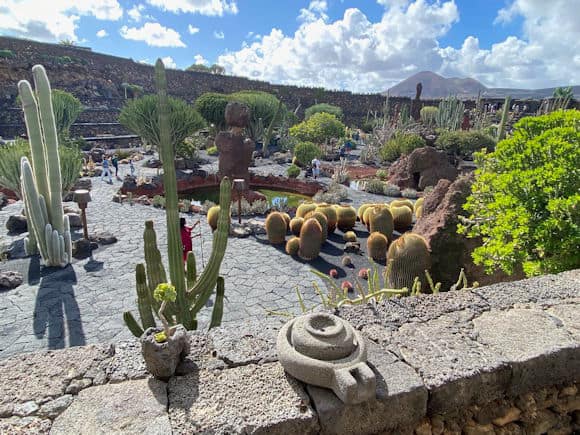
The site is a large 5m deep oval hollow, the focal point of which is a white restored windmill. Manrique created high tiered enclosing walls of the local black stone which form a backdrop for displaying the groups of cacti on terraces, whilst in the centre is a flat area of beds mulched with black pumice and dotted with larval monoliths. Basalt paths meander through this area and there are small pools, but the lack of water flow means these are covered in green algae. The large beautifully-detailed restaurant, shop and art gallery are discreet and seem timeless, and are built of the local stone with large expanses of glass.
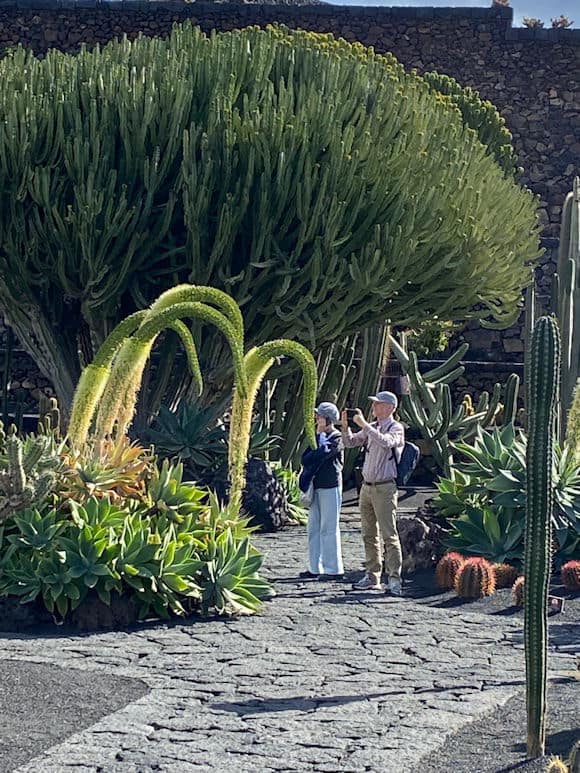
Ferrer curated the 10,000 cacti and succulents from 1,400 different species, grouping them by genus, making it the most comprehensive botanical garden of its type in Europe. However, the architectural qualities of the cacti, much appreciated by Manrique, play a secondary role to their botanical grouping. In late summer and early autumn there is seasonal rain in Lanzarote, and the garden becomes a spectacular flowering display set against its black landscape. Although my visit was in January, with little in flower, I have been amazed, on other occasions, that these strange plants growing in such a hostile environment can produce such a wide variety of flowers, some very large and exotic, and others highly scented. It is an unexpected bonus.
In January 2026 the British Government added the Canary Islands to its voluntary no-travel list. Over-saturation of tourists and subsequent pollution, combined with climate change seem to be the main reasons. In 2025 there were intermittent water shortages (Lanzarote having only 25mm of rain), and wild-fire evacuations. Manrique’s worst fears may be coming true.
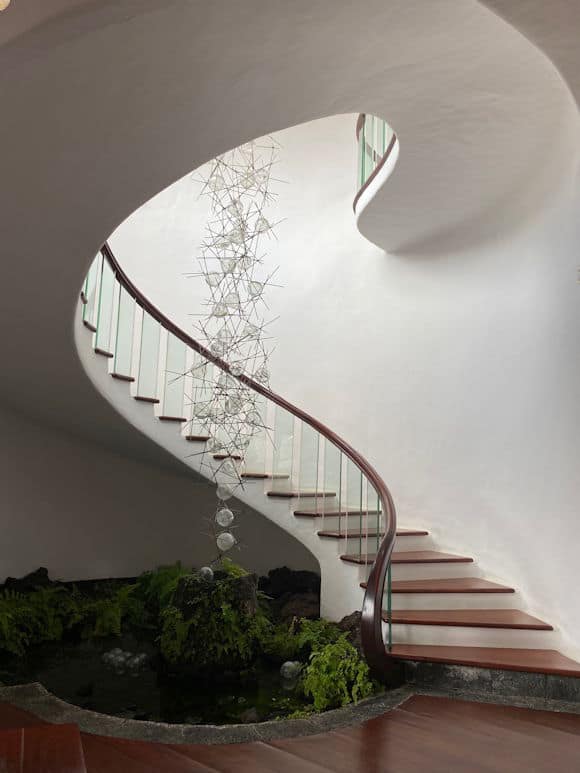
Restaurant Stair
Garden Details:
Website: cactlanzarote.com/en/centre/jardin-de-cactus
Address: Carretera de San Bartolome, 71, 35500 Guatiza, Lanzarote, Spain
Large restaurant
Coffee shop
Shop and Art Gallery
No disabled access.
Opening times: 10.00am – 5.00pm every day, last entry 4.30pm
Richard Jackson 25 December, 2025