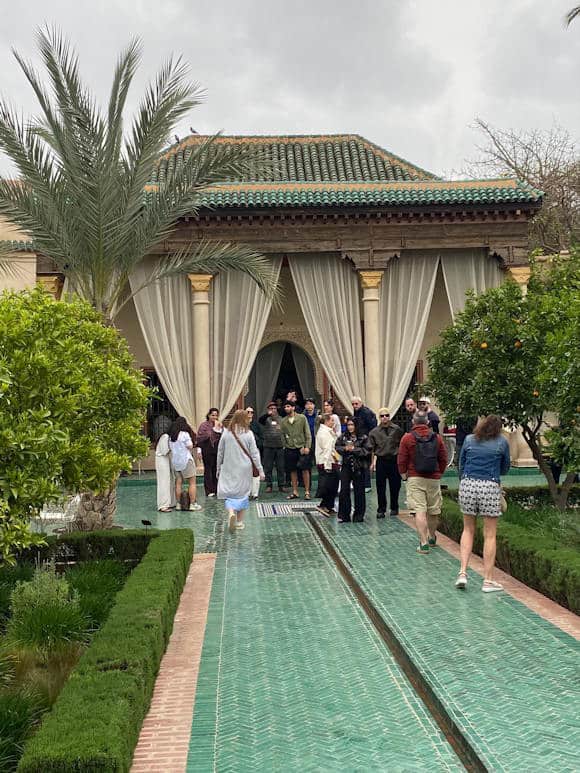
The Paradise Garden, Le Jardin Secret
Marrakech is a city of riads with tranquil courtyard gardens, built around a pool or fountain, and which offers a wonderful antidote to the sensory overload, crowds, dumper trucks, motorcycles and laden donkeys of the medieval Medina.
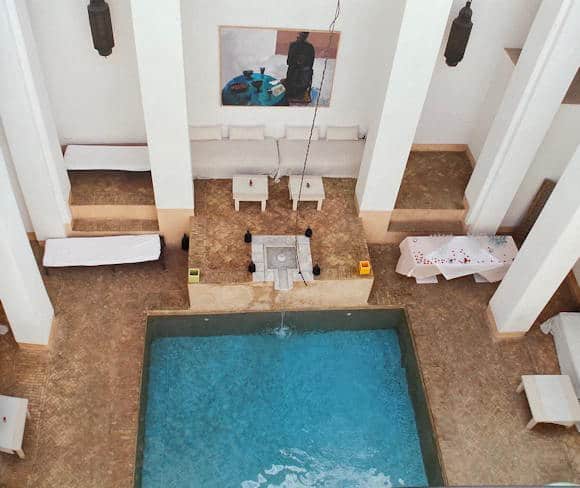
Modern Riad
It is remarkable that since the 11th century such a large city has existed here at all, in this semi-arid location. The camel trains brought salt, gold, ivory and slaves from West Africa and great wealth to the city, and it was at this time the capital of an empire that stretched as far as Zaragoza in northern Spain. The city’s existence was made possible by an extensive network of pipes bringing water to Marrakech from the snow-capped Atlas Mountains, some 30km away, both to the city and to the large agricultural estates, such as the Agdal and Menara Gardens.
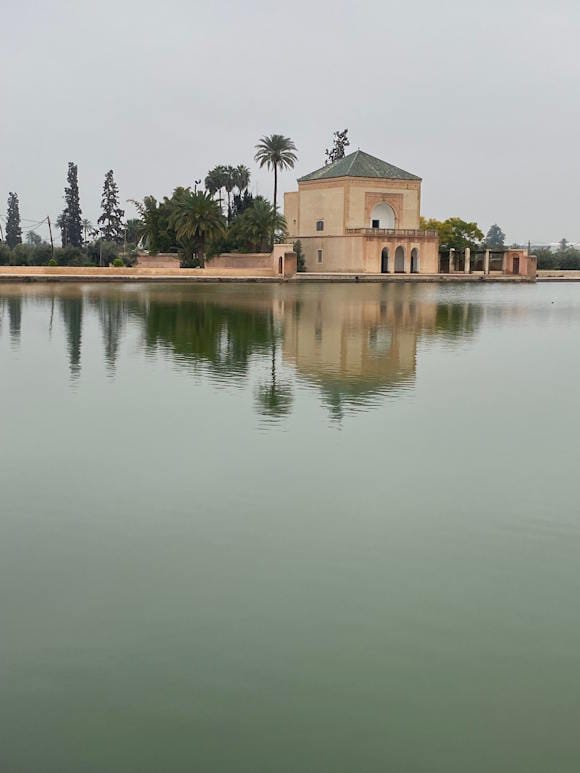
The Menara Garden Water Basin 11thC. with Pavilion 16thC
The term ‘riad’ refers to a traditional Moroccan house or palace. For the wealthier merchants, courtiers and nobility, artisans from across the empire adorned the riads with astonishingly beautiful stuccowork, carved cedarwood and tilework, whilst there were often shaded colonnades to the sides of the courtyard and exuberant planting. The exterior walls were plain apart from an elaborately carved doorway which led to a vestibule from which the courtyard was hidden.
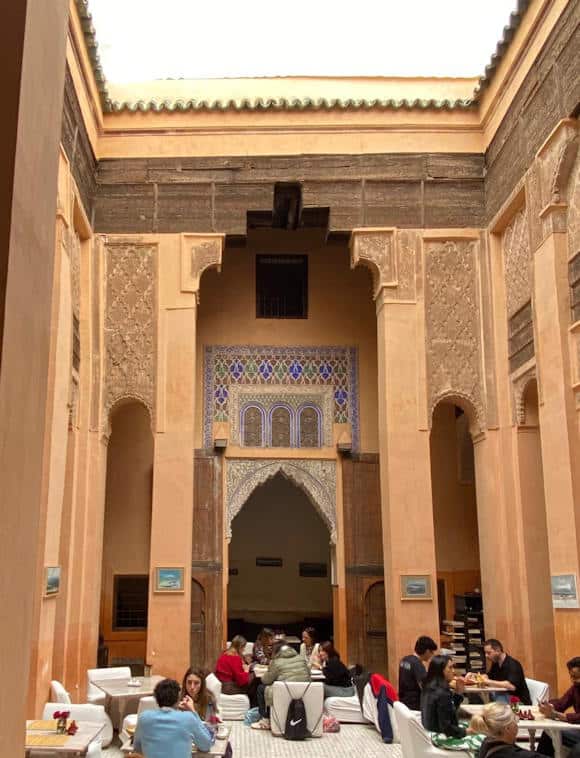
Da Cherifa Riad 16thC.
In larger riads the Iranian-inspired Paradise Garden, full of Quranic symbolism, was more common. Intended as a glimpse of paradise, the garden was divided into four quadrants by intersecting water channels or paths, presenting the four rivers of heaven (water, milk, honey and wine). It was a place for rest and meditation, with the soothing sound of water, scent of orange and lemon trees; with tapestry underplanting of scented jasmine, shrub roses, lilies, tulips, hyacinth and herbs intended to calm the mind and encourage spiritual reflection.
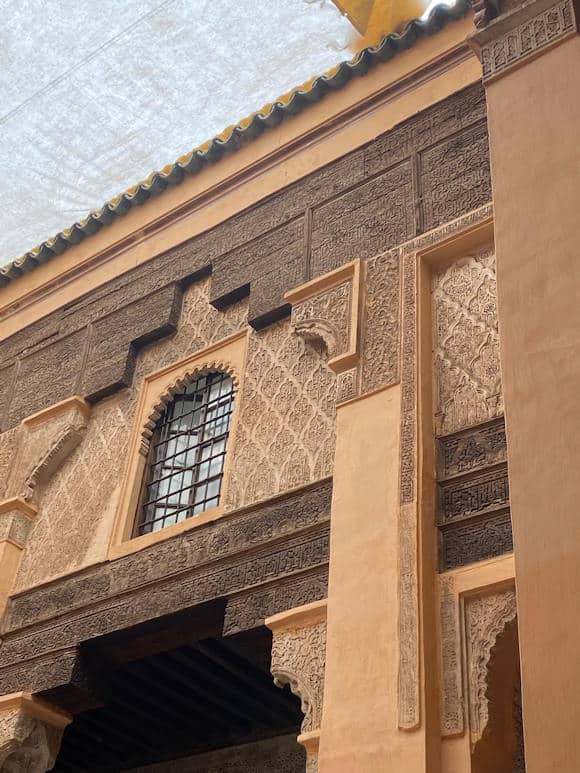
Da Cherifa Riad: Detail
Surprisingly, until Le Jardin Secret was built, there were no paradise gardens in Marrakech open to visitors, except the grand ruins of the 16th.century El Badi Palace. Here, in the central courtyard of the palace, four enormous sunken gardens were arranged around a central pool measuring 90 x 21m. (Twice the length of an Olympic swimming pool.) Following the fall of the Saadian dynasty in the 17th.century, the Palace was stripped of its luxurious materials including its Italian marble wall panels, but it remains a spectacular and evocative ruin.
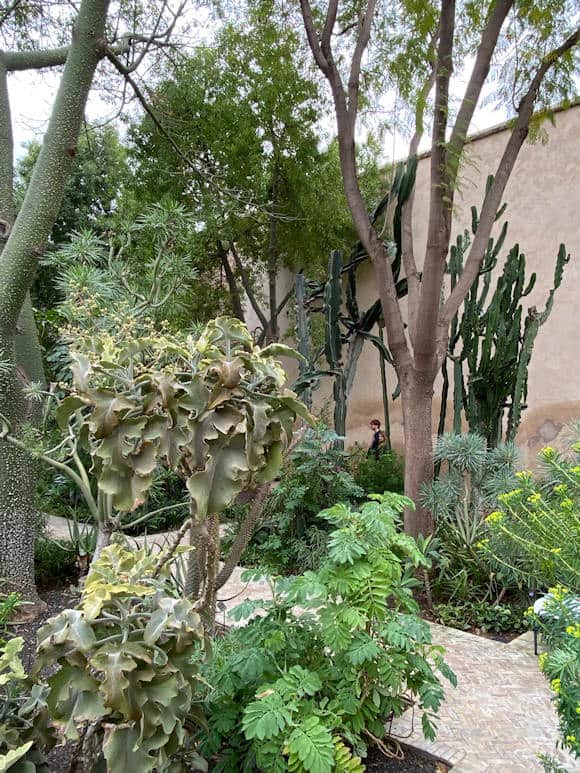
The Exotic Garden, Le Jardin Secret
Le Jardin Secret, was a former 19th.century palace, built over earlier palaces. It was abandoned and fell into disrepair after 1934 following the death of its courtier owner. British garden designer, Tom Stuart Smith was brought onboard in 2012, and with onsite supervision from its Italian owners, the site was cleared and excavated down to its 16th century system of irrigation. There are two gardens, the smaller one being an exotic jungle of mostly North American yuccas, prickly pear, aloes and prairie grasses. The larger one, the Paradise Garden, is set out on traditional lines with a pavilion at each end and at the intersection of the four quadrants, an ornate gazebo with water basin. Pathways are river-like, paved in blue-green traditional enamelled tiles, and narrow adjacent rills irrigate the sunken planting areas.
In the pavilions there are exhibitions on the riad’s history, and unusually a tower that gives an overview of the garden.
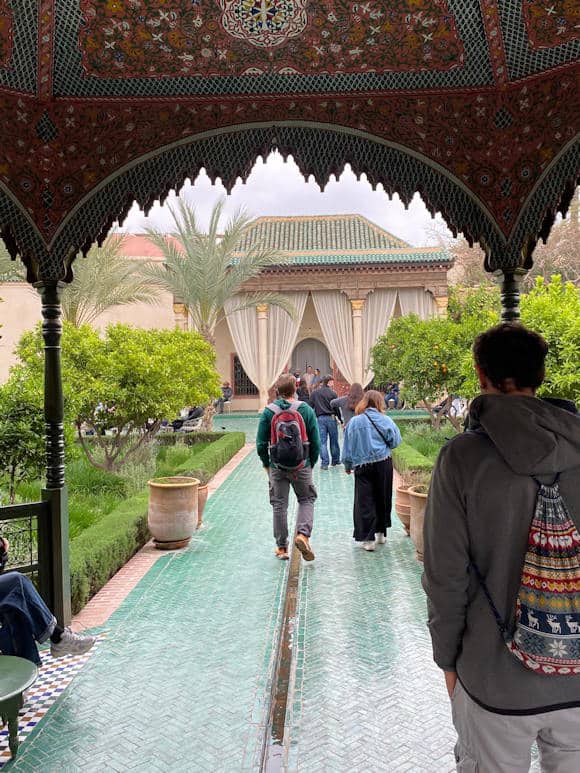
The Gazebo, Le Jardin Secret
However, this prestigious garden was a disappointment to me, and I suspect, others.
There are few places to sit and enjoy the garden out of the sun and away from the jostling crowds, apart from the two busy open-air cafes. One of the main visitor criticisms is that it is not a place to linger. The traditional use of colonnades to the sides of the garden would have provided space for quiet enjoyment.
Flowers are part of the delight of a Paradise Garden and one of the main reasons people visit gardens. Tom Stuart Smith decided not to use the traditional tapestry underplanting, below the fruit trees, but to give it a modern twist, with hedges of rosemary, and mass herbaceous planting of stipa tenuissima (Mexican feather grass). These have become beds of lumpy tufts that in places have died out altogether.
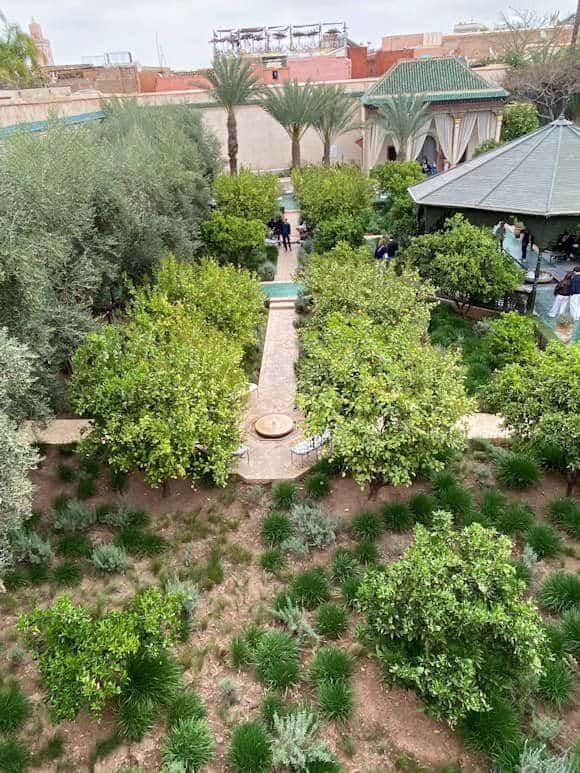
Overview, Le Jardin Secret
Paradise Gardens are noted for their extensive use of water, its sound, its flow, its reflective qualities, its symbolic meaning. The use of water in this garden is underwhelming. Four substantial water basins would have been more in character and a better choice.
The garden is a missed opportunity, and unlike most of the stunning places in Marrakech doesn’t warrant a second visit.
Richard Jackson late February 2026
Garden Details;
Website: www.lejardinsecretmarrakech.com
Address: Rue Mouassine 121, Marrakech 40030, Morocco
Café: Two open-air cafes, one with an overview of the garden
Dogs: No
Disabled Access: A few steps in the garden, but no access available to the tower
Opening Times: Every day 9.30 – 19.30 except Islamic holidays. Advisable to book on line and be there for 9.30am.